Tech Firings Are About Narrative, Not Efficiency

Initial tech layoffs were driven in part by legitimate concerns about efficiency. Starting in 2020, tech companies starting hiring more. A lot more. Too much, by some accounts. And there was very little oversight of what many of them were doing.
However, in 2022, that hiring went in reverse due to a perfect storm: vaccine adoption, rising interest rates, and changes in the tax code. I'll briefly cover this necessary history before moving on to my main argument that layoffs and slow hiring is no longer about efficiency at all.
1) Mass Deployment of the Vaccine
Vaccine adoption changed the Covid risk calculus, and many people who had been staying home started participating in regular activities again. They didn't depend anymore on Zoom or Facebook or other tech services to connect them to the outside world. This also meant a surge in economic activity for the rest of the economy, which boosted interest rates.
2) High Interest Rates
High interest rates hurt exporters and growth companies the most, and tech companies are both. High interest rates boost the value of productive dollar assets as investors chase higher returns, making them less willing to part with those dollars to purchase US made products instead. They also discourage speculative future returns – if I promise you something that may grow 20% a year if things go well, that's more attractive when the alternative is stuffing dollars under my mattress, and less attractive if I can just go to the bank and get 6% on a savings account that's guaranteed. Government debt and other safe assets which are tied to US yields (like mortgages) function similarly for institutional investors. If interest rates are practically zero, I may as well invest in something a bit riskier in the hopes of some kind of return. But if the US government is guaranteeing a 5 or 6 percent return, that speculative investment seems not worth it. And a growth company is speculative by definition.
3) Change in Tax Law
The Republican-passed (and ironically named) Tax Cuts and Jobs Act of 2017 included a provision that made hiring tech workers much, much more expensive from a tax perspective. This was set to take effect in 2022, and most Republicans, to the extent they were even aware of this provision, probably never intended it. It was a gimmick to make the tax cut seem cheaper than it really was.
However, it appears that amid the flurry of changes Democrats were trying to make to reverse actions of the Trump Admin (many of which were legitimately destructive) this particular provision got overlooked - resulting in tech companies staring down an explosive tax burden at the same time their stock was already getting pummeled. They needed to do something to reduce expenses and restore the narratives boosting their stock prices. And they started discovering that layoffs provided that narrative boost.
At this point I think a strong argument can be made that this wasn't just about narrative, and did on some level correspond to actually needed changes. Tech companies had hired like crazy over the preceding few years. Anyone could read a dozen stories a day about workers who had been hired to do basically nothing but collect checks. Too-large firm size can reduce the ability of upper management to actively monitor whether productive work is being done at the lower levels. Other examples of waste include duplicated work, make-work projects that justify promotions but provide no value, and loss of strategic coherence.
4) The End of Labor Hoarding
Once tech companies started laying off workers, a fourth reason for layoffs came into play: the end of labor hoarding. During Covid, tech companies hired more workers than they actually needed because tech workers were becoming scarcer; therefore, companies felt they had to hire now or risk being unable to get the talent they might need later. With employment headed the opposite direction, this reason for hiring abruptly ended. While increased tech unemployment might not be socially beneficial, it is logical for the individual firm to take advantage of this trend.
The Narrative Needed Layoffs
AI producers need to show to investors - and consumers - that the hype is real
Also starting in 2022, a new reason for layoffs emerged - ChatGPT. For years companies had been treading carefully around AI, fearful of regulatory blowback and general fears about the future impact of the technology. Many tech workers gave at least partial credence to the fears of Effective Altruists and others that a general-purpose AI would be impossible to shut down because it would outsmart us, and might create a range of catastrophes ranging from the proliferation of fake news and concentration of power all the way to the total extinction of humanity. Prominent AI labs such as Google's DeepMind were therefore extremely careful to avoid deploying anything that might even approach general intelligence.
It's deeply ironic that the company to end this caution started in service of it. OpenAI, the company behind ChatGPT, received much initial support from the AI safety space. They began as a nonprofit dedicated (at least on paper) to advancing AI safety and preventing catastrophe. A cynical observer might believe that Sam Altman leveraged the resources of concerned people to create the very thing they most feared for his own personal benefit.
When OpenAI dropped ChatGPT they sparked a race that would lead their competitors to drop many safety standards. They also sparked a frenzy of investment into the AI space. ChatGPT broke all records in terms of consumer adoption, and jealous Big Tech companies couldn't simply stand by and allow ChatGPT to destroy their carefully guarded monopolies.
Google feared users would search ChatGPT instead of their site. Meta's near-monopoly on online relationships was threatened by the parasocial relationships users were forming with an AI chatbot. Apple was threatened by their own (relative) lack of consumer data - their competitors would quickly be able to incorporate user data into their AI tools, whereas Apple would face a steeper slope.
Facing a huge investment opportunity on one side and potential strategic catastrophe on the other, tech firms poured billions into their AI tools. However, the patience of investors remains finite especially in the current high-yield environment. Tech firms must show returns on their colossal investments. They had to find customers for these products quickly. But how can you possibly argue that AI will be a cost-saving measure for your customers if your own headcount remains stubbornly high?
Suddenly layoffs weren't just about reducing the impacts of overhiring and returning to a pre-Covid trend. Instead, layoffs were offered as proof that the new tools were working. The pitch seems to be something like: "One developer can now do the work of ten - just look at our own newly-streamlined org. If an AI agent can do the complicated intellectual work of a programmer, how hard could it be to learn bookkeeping or any other white-collar task?"
Programmers newly disempowered in the job market (at least relative to where they were before) were in no position to critique the occasionally scant morals of such tools, with predictable results such as Meta's policies allowing for parasocial romantic relationships with children and xAI generating child porn on demand. Just one more reason for tech CEOs to favor slashing headcount - improving their power over employees.
Unlike the early layoffs, these narrative and power driven layoffs have destroyed value. While AI tools are useful for many purposes, they are not yet capable of replacing most tech workers. And to the extent AI makes workers better at their jobs, that can be just as good a reason to hire more as hire less. AI review systems capable of analyzing millions of code changes, Slack messages, and more, actually solve some of the inefficiency problems of large firms. Workers who can produce more should produce more value for the company as well. But in the short term, layoffs looked good to investors and were rewarded, while companies buying these tools eagerly laid off thousands of their own workers in the (usually mistaken) belief that when their subordinates were forced to adopt AI due to a labor shortage within the firm, the firm would see major savings and even increased growth.
It hasn't generally worked out that way. In surveys about 90% of companies report being dissatisfied with their adoption of AI, with incrementalist changes giving the greatest benefit and mass forced adoption resulting in unforeseen catastrophes such as Klarna's, who laid off seven hundred employees only to see a huge spike in consumer complaints which forced them to rehire many of those positions.
Even the tech companies themselves are seeing problems. While it can be hard to measure total "bugginess" across the tech industry, incidents like an Amazon Web Services outage shutting down a third of cloud computing mere days after announcing major layoffs seem to be increasing in frequency. Data from IsDown.app show that the number of website crashes is more than double today what it was in 2022.
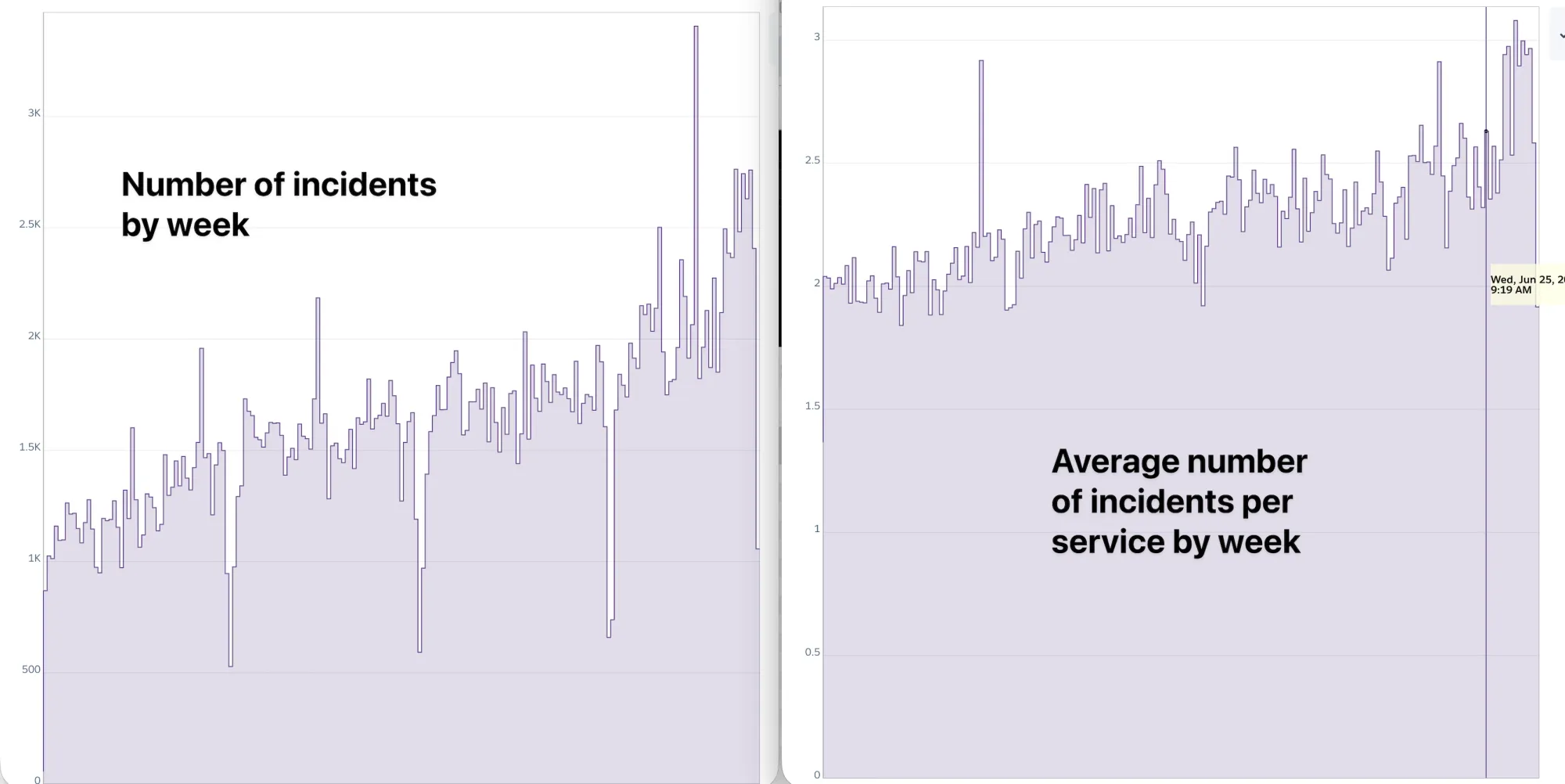
Tech layoffs and slow hiring are no longer about efficiency for the company. They are even less beneficial for society as a whole, as companies push broken products and unsafe AI tools on the public. Yet as tech unemployment continues to inch upwards even as share prices reach record highs, it doesn't seem this behavior will be punished by the market anytime soon. But while AI might boost growth, these layoffs will not.
As for the CEOs themselves? They seem to enjoy their increased power over workers.